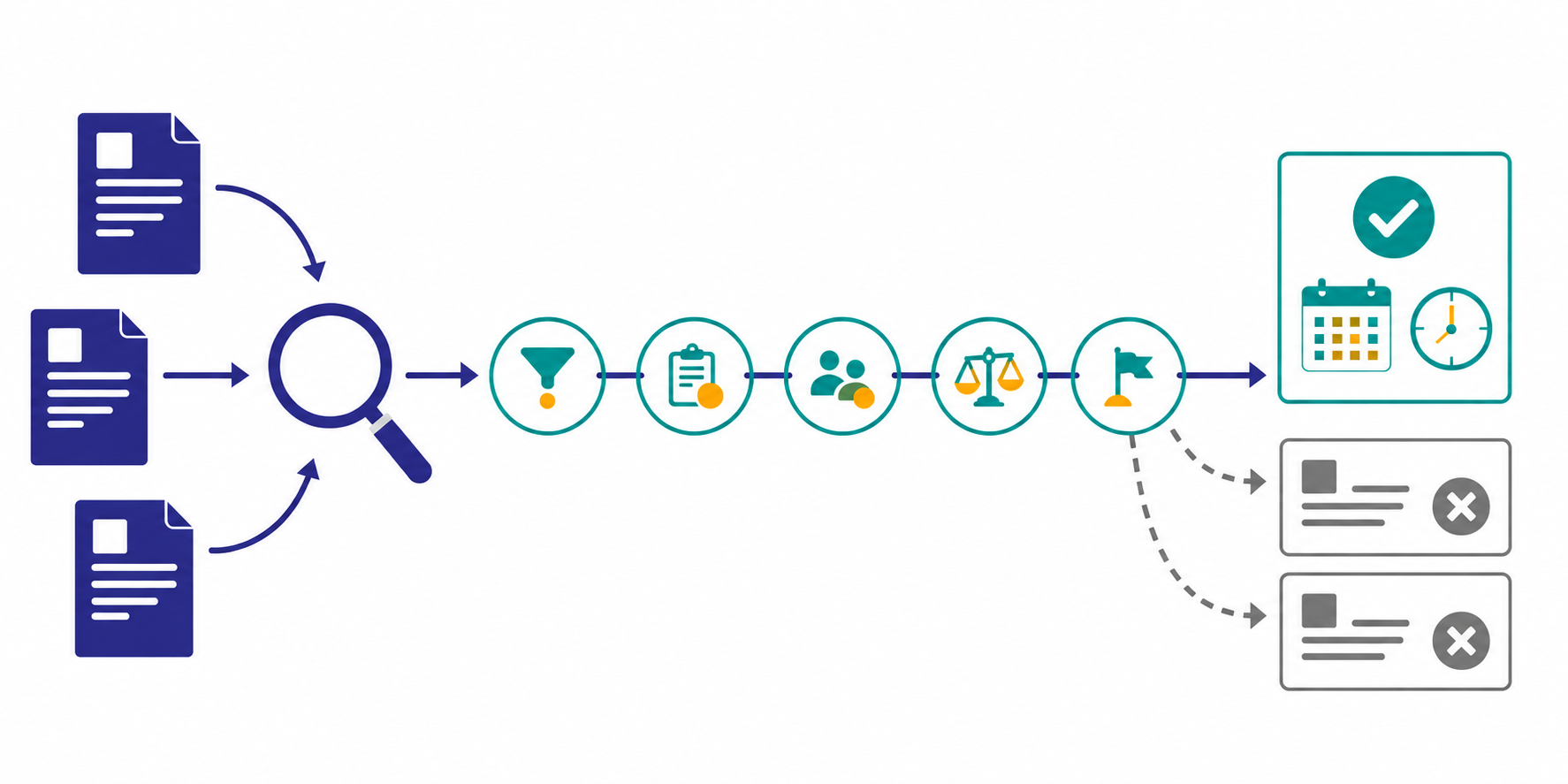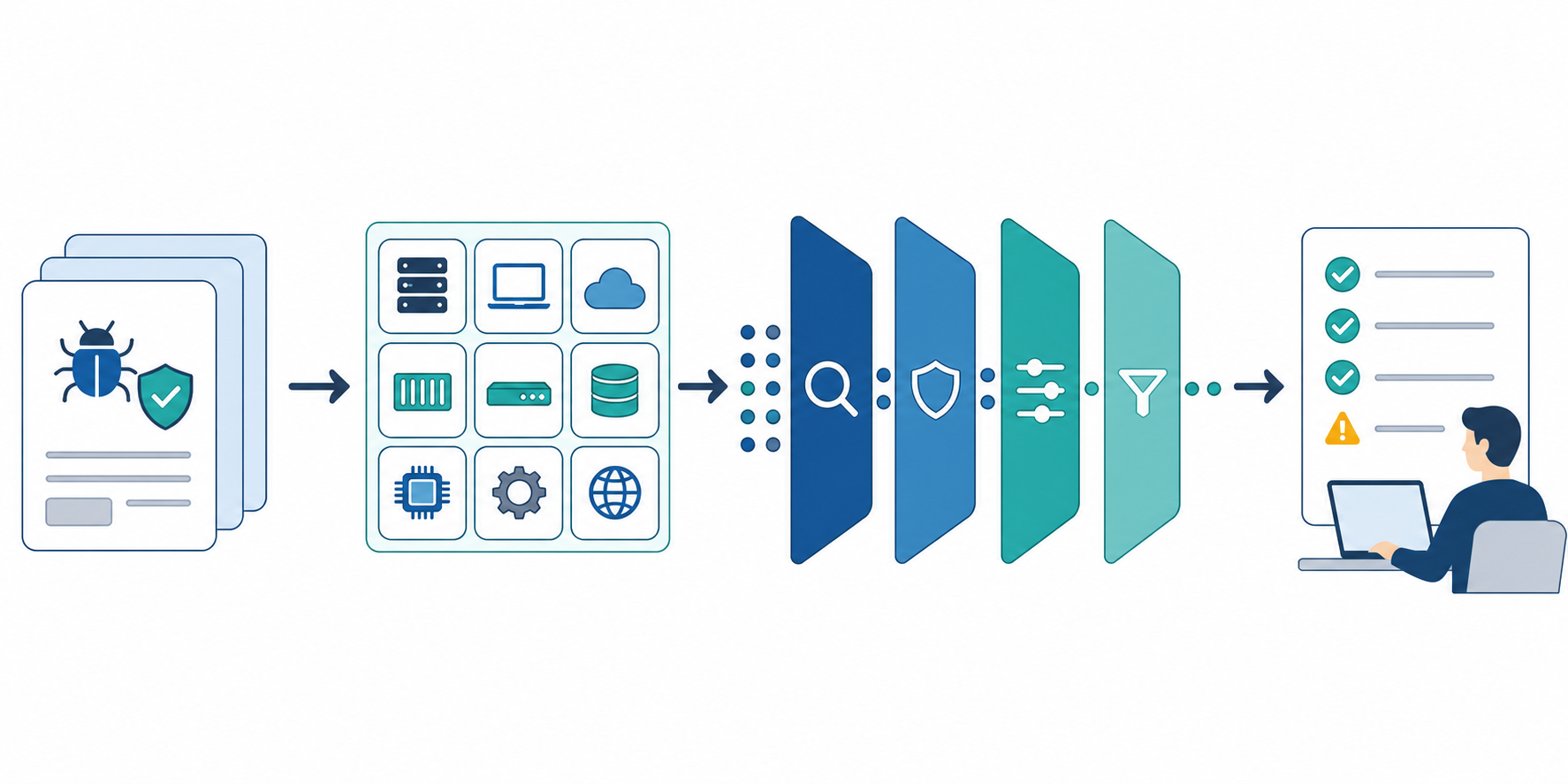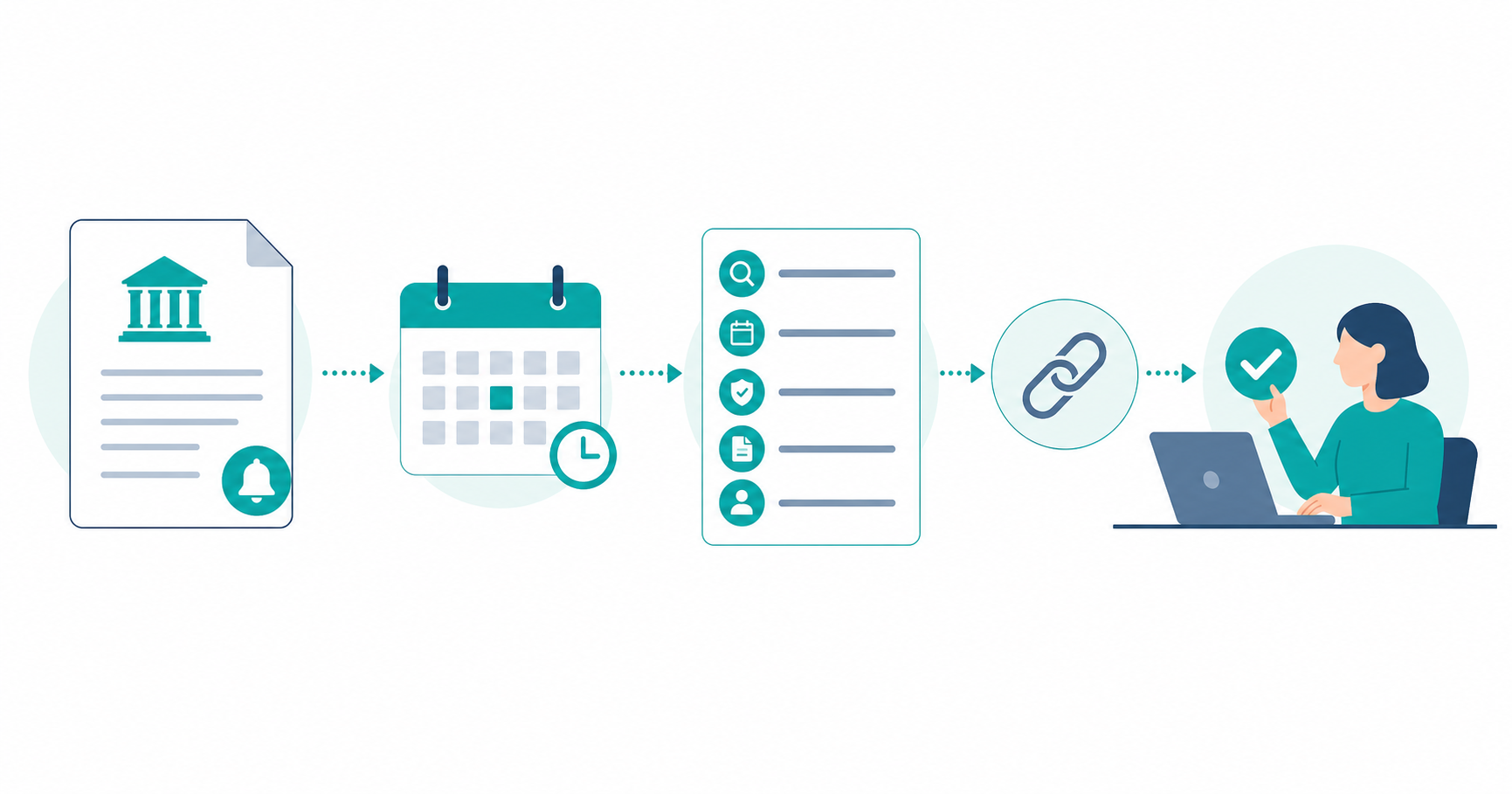
Finding a regulatory update quickly is not the same as understanding what to do with it. A team still needs to distinguish a binding text from guidance, identify the effective date, check whether the scope includes its products or operations, and review the primary source.
This article explains how to monitor public regulator and standards-body pages and turn updates into structured review notes. It does not automate legal judgment. Legal, compliance, or subject-matter owners should verify applicability and actions against the original text.
The short answer: automate collection, not applicability decisions
- Prioritize primary sources from regulators, ministries, and standards bodies.
- Record
Change / Effective date / Scope / Action / Evidencefor every material update. - Keep enacted rules, drafts, consultations, and FAQ revisions separate.
- Use AI summaries to narrow the review queue, never as a substitute for the source.
- Assign an owner and review deadline so an alert becomes a controlled task.
Regulatory timelines can change while implementation work is underway. As of June 2026, the European Commission's official AI Act page covers the phased application that followed the Act's August 2024 entry into force and reports an updated implementation path after a May 2026 political agreement. That is a practical reason to retain the official URL and checked date instead of copying a deadline into a static spreadsheet.
Separate four kinds of regulatory updates
Updates from the same authority can carry different legal and operational weight.
| Update type | What to verify | Initial handoff |
|---|---|---|
| Law or regulation | publication, application, transition, scope | route the text and transitional provisions to the owner |
| Guideline | version, changed sections, audience, recommendations | compare it with the previous version |
| Draft or consultation | deadline, open questions, draft status | ask affected teams whether input is needed |
| FAQ or explainer | revision date, examples, relationship to the rule | check whether an operating procedure is affected |
News coverage and law-firm analysis can help a team discover an issue. The review note should still link back to the authority's page or official document.
Step 1: define a topic as “rule × operation”
“Monitor all AI regulation” is too broad to route. Start with a specific rule area and the operation it may affect.
| Watch topic | Related operation | Primary source types |
|---|---|---|
| AI transparency requirements | product disclosures, terms, customer communication | regulator policy page and FAQ |
| Personal-data handling | collection, storage, processors | authority rules and guidance |
| Security guidance | engineering, procurement, incident response | government and standards bodies |
| Sector rules | sales, approvals, record retention | sector regulator and ministry |
For each topic, set an owner, region, review cadence, and escalation condition. One to three topics that map to real decisions are enough for the first monitoring cycle.
Step 2: register sources by role
A policy landing page may not expose every document revision. Monitor pages with different roles separately.
- Policy landing page: scope, application timeline, and links to implementation material
- News or press page: publication, amendments, meetings, and consultations
- Official documents: legal text, guideline PDFs, and revision histories
- FAQ or implementation page: definitions, examples, and submission procedures
Stratum Flow accepts one Seed URL per job. Put a policy page and its document index in separate jobs, then ask a different question of each. Seed URLs: Usage and Examples explains how to define those starting points.
Step 3: produce a five-field change note
A fixed structure makes it easier to compare actionability instead of update volume.
| Field | Record | Example |
|---|---|---|
| Change | the verifiable revision | implementation guidance for transparency rules was updated |
| Effective date | entry into force, application, or deadline | August 2026; exceptions follow separate dates |
| Scope | region, entity, product, or activity | certain AI systems offered in the EU |
| Action | what a person must verify next | legal reviews affected features and customer disclosures |
| Evidence | official URL, document, checked date | policy page, legal text, checked 2026-06-19 |
Write a review task in Action, not an automated legal conclusion. “Confirm whether the product falls within the defined scope” is safer and more useful than an unsupported “compliance is required.”
Step 4: add exclusions to the research instruction
Authority pages also publish events, staffing news, and navigation changes. State what the report should ignore.
From updates since the previous review, extract only changes related to laws,
regulations, guidelines, consultations, or implementation FAQs.
Return Change / Effective date / Scope / Action / Evidence.
Separate final measures from drafts. If the source does not confirm a date or scope,
write “needs review.” Exclude events, hiring news, and visual page changes.
See How to Write Effective Research Instructions for ways to keep output criteria and formats stable across runs.
Step 5: prioritize with date × impact × certainty
Sending alerts in discovery order makes a draft consultation look as urgent as an approaching statutory deadline. Use three review dimensions.
| Dimension | Higher priority | Lower priority |
|---|---|---|
| Date | near deadline or short transition | no date or early policy discussion |
| Impact | current product, contract, or operation may be affected | region or activity is outside current scope |
| Certainty | enacted text, final guidance, authority FAQ | draft, speech, third-party commentary |
If one dimension is unknown, label it as missing information. Do not automatically turn uncertainty into a high-confidence alert.
Step 6: record the human review
Add these fields to the internal handoff:
Owner:
Review due:
Applicability: applicable / not applicable / unclear
Decision:
Required follow-up:
Reviewed evidence:
Without this state, the same update can return every week as an unresolved alert. Record the date and evidence even when the owner decides that the change does not apply.
Example: monitoring AI rules and frameworks
An AI governance watch should not collapse materials with different status into one “requirements” list.
- European Commission AI Act page: application timelines and implementation material
- NIST AI Risk Management Framework: a voluntary risk-management framework and related profiles
- National regulator guidance: local scope, version, and revision history
NIST describes the AI RMF as voluntary and also publishes a Generative AI Profile. That makes it useful operational guidance, but not equivalent to a binding regulation. The first classification should preserve that distinction.
Common pitfalls
1. Monitoring news coverage only
Coverage is useful for discovery, but may omit exceptions or transition details. Keep the official URL and document title in the review note.
2. Treating a document diff as a legal conclusion
A changed sentence does not always change an obligation. Show the difference, then have the owner review surrounding provisions and notes.
3. Mixing application dates and operational deadlines
Publication, entry into force, application, transition, and filing deadlines can differ. Label the type of date in the Effective date field.
4. Sharing an AI summary as legal advice
Mark the output as a review note. Applicability, contract changes, and customer communications require review by an authorized owner using the primary text.
When Stratum Flow fits
Start with one rule area that already has an owner and a review deadline.
- Set the authority's policy page as a Seed URL.
- Add the five-field format and exclusions to the research instruction.
- Verify source URLs, dates, and scope in the first report.
- Run weekly or monthly and investigate only the missing fields.
- Store the owner's decision and evidence in the team's system of record.
Stratum Flow can collect public web information and produce reports with source URLs. It does not replace legal analysis. Validate the handoff from detection to human review with one rule area before expanding the watchlist.
Summary
Regulatory and guideline monitoring works when update detection and applicability decisions remain separate. Fix the primary sources, capture the change, date, scope, next review, and evidence, then route the original material to a responsible owner.
Next step
Try Stratum Flow and start monitoring an official source